
Having been in this game a long time, I think I’ve hit on a real disconnect in B2B.
We’ve conflated communication volume with relationship strength.
More emails. More sequences. More meetings. More pings. More “just checking in.” More activity logged in the CRM. The premise being: more in the top, more sales out the bottom.
In practice, a lot of modern go-to-market motion creates what I’d call relationship debt. We ask for time we haven’t earned. We send messages that carry no real signal. We schedule meetings to solve problems that could (should?) have been handled asynchronously. Then, when something actually requires a real conversation, the relationship has already been weakened by the noise.
So I’ve been working through a theory. I call it the Matrix of Impact.
The idea is simple:
The best relationship builders do not default to the most efficient channel. They choose the richest appropriate channel for the moment.
That last phrase matters: for the moment.
Because the “best” channel is not always the most human one. Sometimes a call beats an email. Sometimes an email beats a call. Sometimes a voice note builds more trust than a 30-minute meeting. Sometimes the only thing that will do is getting on a plane.
The art is knowing the difference.
The Relationship Bandwidth Ranking
If I rank communication channels by how much human signal they can carry, my current list looks like this:
Synchronous:
- In person
- Face-to-face video
- Phone
Asynchronous:
- Voice notes / voicemail / voicemail-to-SMS
- Text / WhatsApp / Signal / IM
This ranking feels intuitive to me, and, in digging around, I found there's actually research behind it.
Media Richness Theory, developed by Daft and Lengel in the 1980s, argues that channels differ in how many cues they can carry: words, tone, facial expression, gaze, gesture, posture, and immediate feedback (overview at Wikipedia). Face-to-face sits at the top because it carries all of them.
In person, you get the full room. The words. The pause before the answer. The look across the table. The thing someone says after the formal meeting ends.
Video gives you some of that.
Phone gives you voice, but not visual context.
Voice notes give you tone and humanity, but no real-time feedback loop.
Text gives you speed, but limited nuance.
Email gives you structure, documentation, and scale, but it is usually the weakest relationship-building medium.
That doesn’t make email bad. It makes email limited.
And this is where many GTM teams get into trouble: they treat every channel as if it does the same job.
Communication Has Two Jobs
One of the most useful distinctions I’ve found comes from Media Synchronicity Theory (Dennis, Fuller & Valacich, MIS Quarterly, 2008 — paper), which splits communication into two jobs:
- Conveyance — moving information.
- Convergence — creating shared understanding.
The theory’s argument: lower-synchronicity channels (like email) tend to work better for conveyance, because people have time to process, revisit, and respond carefully. Higher-synchronicity channels (like in-person or video) work better for convergence, because people can clarify, question, react, and resolve ambiguity in real time.
That distinction is incredibly useful for B2B.
Because a lot of our communication problems come from using convergence channels for conveyance, or conveyance channels for convergence.
We schedule a meeting to read out information that should have been sent ahead of time.
We send an email when the real issue is confusion, concern, tension, or a lack of trust.
We use Slack for conflict. Or, Zoom for status updates.
We depend on sales automation for something that should have been a thoughtful human follow-up.
Then we wonder why everyone is exhausted and nobody feels closer.
Richer Is Not Always Better
If this were only about relationship bandwidth, the answer would be simple: meet in person whenever possible.
But that’s not just unrealistic, it’s obviously wrong.
A poorly timed in-person meeting is not better than a well-timed email. A surprise phone call is not automatically more relational than a thoughtful text. A video call at the end of a brutal day may create less trust, not more.
That’s why the Matrix of Impact needs two dimensions: human richness and timing / permission.
A channel can carry a lot of humanity and still be the wrong choice if it interrupts, pressures, or over-asks.
That “quick call?” that is not quick. (I've stricken this from my phone call vocab, it's just a lie)
The video meeting with eight people where two talk. (I think everyone can relate to this one)
The internal alignment meeting where it's performative collaboration instead real organized work.
The scale of the problem is now well documented. Microsoft’s 2025 Work Trend Index (built on data from trillions of Microsoft 365 signals) found that knowledge workers are interrupted by a meeting, email, or chat roughly every two minutes during core work hours, adding up to about 275 interruptions a day. Half of all meetings now land between 9–11 a.m. and 1–3 p.m., the exact windows when people have natural cognitive peaks (Microsoft WorkLab, Breaking Down the Infinite Workday, 2025).
So yes, synchronous communication is powerful.
But it is also expensive. Not just financially. Cognitively. Emotionally. Relationally.
When you ask for someone’s live attention, you are spending trust.
Make sure the moment deserves it.
Voice, the Most Underrated Channel in B2B
The more I think about this, the more I believe voice deserves a much bigger role in modern go-to-market.
Not necessarily phone calls.
Voice.
Voice notes. Voicemails. Short audio follow-ups. Thoughtful messages someone can hear, but without any pressure to answer in the moment.
Voice sits in a strange and valuable middle ground. It carries humanity without demanding simultaneity.
A 2017 study by Juliana Schroeder, Michael Kardas, and Nicholas Epley — The Humanizing Voice, published in Psychological Science — found that hearing someone explain their beliefs made the person seem more mentally capable and more human than reading the exact same words in text. The effect held even (and especially) across disagreement (SAGE / Psychological Science; PubMed summary).
The medium changes the impression. That should make B2B teams pause.
Because so much of what we do now strips the voice out of communication.
We automate the email.
We templatize the follow-up.
We let AI write the recap.
We optimize for speed and consistency.
And the buyer receives something technically correct but emotionally empty.
A 45-second voice note — or a short Loom — can cut through that.
Not always. Not for everyone. Not as a gimmick.
But in the right moment, voice can do what a 500-word email cannot: remind someone there is a person on the other side.
Buyers Want Autonomy Until They Need Confidence
This isn’t only a communication topic. It’s a go-to-market topic.
B2B buyers are more independent, more digitally enabled, and more resistant to unnecessary seller interaction. Gartner has documented this repeatedly — most famously, that 75% of B2B buyers prefer a rep-free sales experience, while at the same time noting that self-service-only digital purchases are significantly more likely to result in purchase regret (Gartner, The B2B Buying Journey).
What’s striking is the most recent twist. In August 2025, Gartner predicted that by 2030, 75% of B2B buyers will prefer sales experiences that prioritize human interaction over AI, citing a reversal of the long trend toward fully digital, rep-free buying as AI saturates the early stages of the journey (Gartner press release, 2025).
Forrester’s State of Business Buying, 2024 adds the urgency: 86% of B2B purchases stall during the buying process, and 81% of buyers express dissatisfaction with the provider they ultimately choose. Even though buyers rely heavily on self-service to make decisions, they still need providers to understand their challenges, respond to their needs, and collaborate on the decision (Forrester press release, 2024).
That is the tension:
Buyers don’t want unnecessary human interaction... But they still need human help.
They want autonomy... Until they need confidence.
They want digital... Until the decision feels risky.
They want async... Until the ambiguity gets too high.
The best GTM teams will not win by forcing every buyer into a meeting-heavy process. They also will not win by hiding behind content, automation, and self-service.
They will win by knowing when to move up and down the Matrix of Impact.
The Matrix of Impact
Here is the working model.
Every communication choice has two questions behind it:
- How much humanity does this moment require?
- How much interruption have we earned?
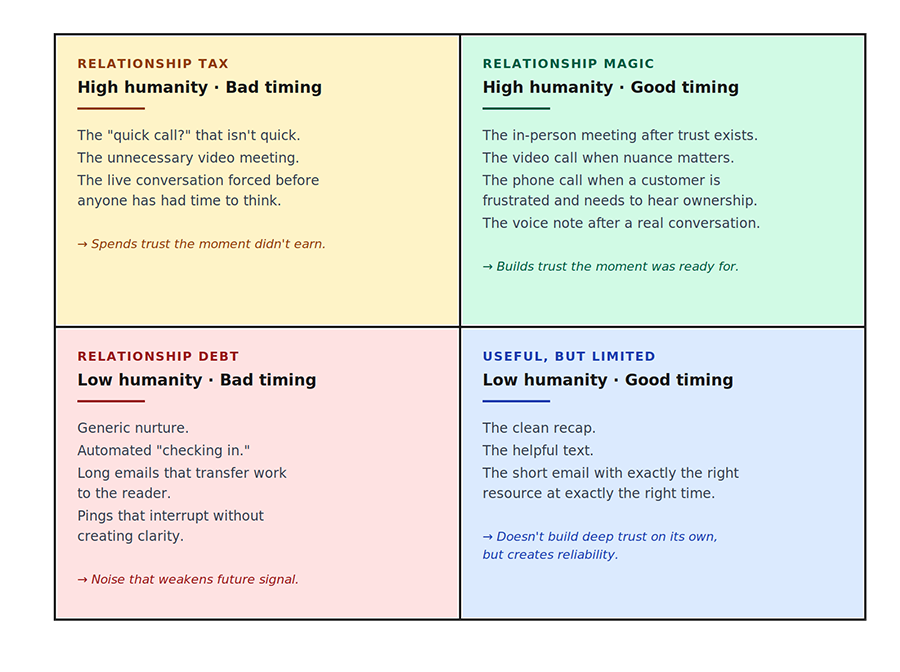
That creates four quadrants:
High humanity / good timing — relationship magic. The in-person meeting after trust exists. The video call when nuance matters. The phone call when a customer is frustrated and needs to hear ownership. The voice note after a meaningful conversation.
High humanity / bad timing — relationship tax. The “quick call?” The unnecessary video meeting. The live conversation forced before anyone has had time to think.
Low humanity / good timing — useful, but limited. The clean recap. The helpful text. The short email with exactly the right resource at exactly the right time. It may not build deep trust on its own, but it creates reliability.
Low humanity / bad timing — relationship debt. Generic nurture. Automated “checking in.” Long emails that transfer work to the reader. Pings that interrupt without creating clarity.
The goal is not to always choose the richest channel.
The goal is to choose the lowest-friction channel that carries enough humanity to do the job well.
- Use email when the job is documentation.
- Use text or IM when the job is quick coordination.
- Use a voice note when tone matters but urgency does not.
- Use the phone when ambiguity, urgency, or emotion requires live exchange.
- Use video when visual context improves trust or clarity.
- Meet in person when the relationship, complexity, or stakes justify the investment.
That sounds simple, but most teams don’t operate this way. They default to whatever their workflow encourages.
Sales sequences default to email.
Internal teams default to meetings.
Remote teams default to video.
Executives default to the channels/motions that made them successful 15 years ago.
RevOps measures the activity, but not the relational impact.
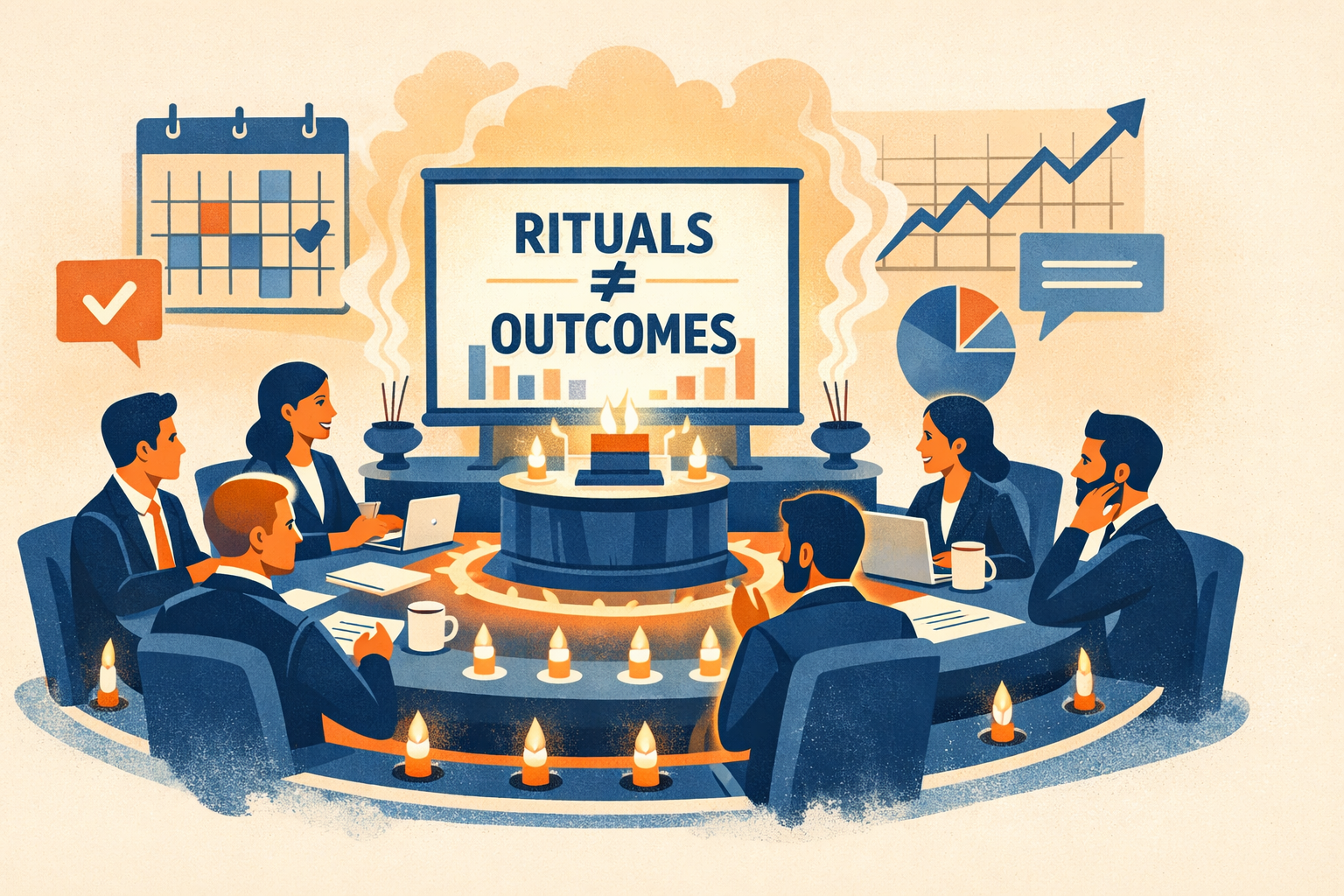
The channel becomes habit instead of strategy. Ritual over outcome.
The Missing Variable: Permission
There is one more word that belongs in this conversation: permission.
A phone call can feel generous or invasive.
A meeting can feel useful or presumptuous.
A text can feel personal or inappropriate.
The channel itself doesn’t determine the impact. The relationship does.
If we have a strong relationship, a spontaneous call may feel welcome. If we don’t, it may feel like an interruption.
Imagine the difference between a text from a friend vs. a cold text inviting you to demo a SaaS product -- Yikes!
If you just helped me think through a real business problem, a voice note may feel thoughtful. If you’re the fifth vendor chasing me this week, it may feel like another tactic.
This is why intent isn’t enough. The sender’s intent might be good. The recipient’s experience is what matters.
And that is where many go-to-market systems are miscalibrated. They optimize the sender’s motion instead of the buyer’s experience.
Where I’ve Landed (For Now)
The caveat might be the whole point:
A well-timed lower-richness message can beat a poorly timed higher-richness interaction.
The best relationship builders are not just better communicators. They are better readers of context.
They know when to show up.
They know when to back off.
They know when to write.
They know when to call.
They know when silence is better than another touchpoint.
As AI makes it easier than ever to generate more communication, the scarce skill won’t be sending.
It will be choosing.
What I’m Still Curious About
This is a working theory, not a finished one. I’d genuinely like your pushback/feedback/opinion on it. A few questions I keep coming back to:
- When has a lower-fidelity channel created a stronger relationship moment for you than a higher-fidelity one?
- Is voice the most underrated channel in B2B right now — or am I overweighting it?
- Where do GTM teams overuse meetings because they’re afraid to write clearly? And where do teams hide behind email or Slack because they’re avoiding a hard conversation?
- Does the right channel change depending on the motion — prospecting vs. negotiating vs. onboarding vs. retaining vs. expanding?
- As AI generates more and more communication, does the human voice become more valuable — or just more performative?
I don’t have clean answers yet. But I am pretty convinced of this:
The future of B2B relationship-building will not belong to the teams that communicate the most. It will belong to the teams that best understand when, how, and why to communicate.
If you’ve got a counter-example, a sharper framing, or a story where this model breaks, I want to hear it.