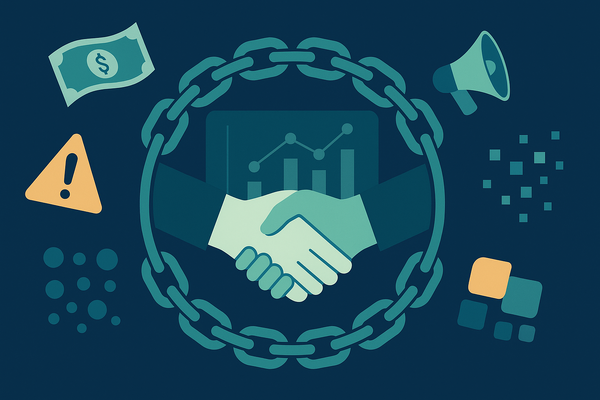

“Trust is the new currency.” OK… but what does that actually mean for GTM?
Marc Benioff has been banging the “trust” drum for years.
At Davos and Milken he’ll say some version of: trust is our highest value, nothing matters more than the trust we have with customers, employees, partners, and communities — and we have to operationalize it, not just put it on a slide. (Salesforce)
I read an article last week from Selling Power founder Gerhard Gschwandtner which took that a level deeper. He describes an invisible global trust network; elite circles where big deals and ideas move fast because trust is assumed. In those circles, he says, the real currency isn’t money, it’s trust. He describes technologies that are emerging to make that trust more visible and more accessible. (LinkedIn)
Put those two together and you get a pretty direct provocation for anyone running go-to-market:
If trust is the new currency, then your GTM plan is either a functioning financial system, or a black market of side deals and creative reporting.
The question isn’t “Do we value trust?”
It’s: Where, exactly, does trust live in our GTM engine, and can anyone see the balance sheet?
Three layers of trust that make (or break) a repeatable GTM motion
When we talk about trust in GTM, we’re really talking about three overlapping layers:
- System trust – Do people believe your data and process?
- Market trust – Do buyers believe your story and experience?
- Network trust – Do the right people trust each other enough to move fast?
If any one of those is broken, “repeatable” is little more than hope.
1. System trust: the RevOps layer
This is Benioff’s sweet spot: data, platforms, and operating model.
If your reps, leaders, or board don’t trust:
- your pipeline numbers
- your stage definitions
- your forecasts
- your attribution
…they’ll come up with their own back-channel versions in private spreadsheet pivot tables. Much like the uncle you have who stuffs cash under the mattress because he doesn’t trust the bank.
System trust looks like:
- One real system of record: The “official” numbers come from one governed place, not pulled from five disparate data sources.
- Stable definitions: MQL, SAL, SQL, “Stage 3”, all explicitly defined, written down, and not quietly redefined mid-quarter.
- Visible assumptions: Conversion rates, ramp time, cycle length, the math behind the plan is clearly documented, not in some RevOps analyst’s private notebook, or their head.
This is exactly why Salesforce keeps tying “trust is the new currency” to AI and Data Cloud: if your data isn’t trusted, your AI is untrustworthy by design. (launchconsulting.com)
RevOps’ job in this layer:
You need to behave like a central bank, thinking of the macro. Set the rules of the system, protect the integrity of the data, and make sure everyone is transacting in the same “currency”.
2. Market trust: the buyer's experience of your promises
This is where “trust is the new currency” meets your website, your sales deck, and your renewal calls.
Market trust is built (or destroyed) when:
- Your claims match reality. ROI models, benchmarks, and customer logos aren’t your fantasy basketball team.
- Your sales cycle, counterintuitively, includes “no” and “not yet” for bad-fit deals.
- Your post-sale experience feels like a continuation of the same story, not a bait-and-switch.
Think of it like this: every interaction either credits or debits the trust “account”—Think Steven Covey’s Emotional Bank Account (Forbes)
The “elite trust networks” Gerhard describes work the same way: you get invited into bigger rooms when people trust that you won’t embarrass them, over-promise, or flake. Your company has that same reputation with buyers. (LinkedIn)
RevOps’ job in this layer:
Make the story measurable. Define what “good” looks like in qualification, handoffs, onboarding, and success. Tie those qualitative trust moments back to concrete process and metrics, so “we’re trusted” is more than a vibe.
3. Network trust: who actually gets pulled into the room?
Network trust: who actually gets pulled into the room?
This is the piece we don’t talk about enough in GTM.
Inside your company and in your market, there’s already an invisible trust graph:
- Certain reps always get pulled into strategic deals.
- Certain CSMs get the prickly accounts.
- Certain execs get invited into customer’s internal Slack channels, WhatsApp groups, private dinners, etc.
That’s the same dynamic Gerhard is pointing at with global elite circles, but at your company’s scale. People route opportunity through the people they trust.
You can either pretend that’s random, or you can:
- Map it – Who’s naturally in the middle of your internal and external trust networks?
- Strengthen it – Pair new reps with trusted “bridge” people; deliberately bring more functions into high-trust customer relationships.
- Democratize it – Don’t let a couple of founders and one top AE be the only ones with access to the real conversations.
RevOps’ job in this layer:
Shine a light on the network. Instrument multi-threading, track who’s in which deal, which internal people show up in closed-won vs. lost, and help leadership design for more people to participate in high-trust loops, not fewer.
Five guiding principles for a trust-centric GTM engine
Bringing those layers together, here are principles that sit nicely in the overlap between Benioff’s system view and Gerhard’s network view:
- One shared reality beats ten pretty reports
If you spend more time arguing about numbers than trying to draw insights from them, you have a trust problem, not a reporting problem. - Consistency beats heroics
A “repeatable” GTM motion that changes definitions, territories, and process every quarter isn’t repeatable. Elite trust networks value patterns of behaviour; your customers do too. That doesn’t mean stagnate, but rather build the review and change into the repeatable process. - Transparency > spin (internally and externally)
Make assumptions visible. Show how forecasts are built. Be clear about product gaps and roadmap tradeoffs. People understand that perfect can be the enemy of good, and will forgive imperfection, but they will not forgive being misled. - Fair rules, written down
If comp plans and territories feel like a black box, internal trust collapses. And when internal trust collapses, every deal becomes a zero-sum fight. True collaboration starts with visible integrity. - RevOps owns “how we tell ourselves the truth”
Not just dashboards. RevOps becomes the steward of definitions, data quality, and operating rhythm. These are the people who make sure the GTM engine lives in the real world, not the land of make-believe.
Small first steps any organization can take this quarter
You don’t need a Davos invite or a trust-tech platform to start acting like trust is your currency. Here are practical moves you can make right away:
- Do a “trust audit” on your GTM system
Grab a small cross-functional group (Marketing, Sales, CS, RevOps) and ask three brutally simple questions:
- What numbers do you actually trust?
- Which processes do people quietly route around?
- Where do customers most often feel surprised or misled?
Turn that into a short list of “top 5 trust leaks” to fix.
- Lock in your core definitions
Agree on:
- ICP
- MQL / SAL / SQL (or your equivalent)
- Entry/exit criteria for every stage in the pipeline
Write it down, update your CRM to reflect it, and refer back to it in every forecast and campaign review. Make sure there is buy-in here from the people working in the system, as a directive from a decision-maker can frustrate this immensely.
This single step eliminates a massive amount of “I don’t believe those numbers” drama.
- Publish a one-pager: “How we handle truth here”
Skip the values poster. Write a plain-language doc that says:
- What leadership commits to (no changing KPI definitions mid-quarter, no sandbagging forecasts, no backdating opps for optics).
- What GTM teams commit to (accurate CRM updates, honest deal reviews, no overoptimistic stage progression).
You’re defining how your internal trust network is supposed to behave.
- Make data quality your first AI project
Before launching flashy GTM AI pilots, do something aggressively boring:
- Pick a few high-leverage fields (Stage, Amount, Close Date, Primary Contact, Use Case).
- Set simple rules for completeness and accuracy.
- Report weekly on data health and close a few loops with reps and managers.
If trust is the new currency of AI, this is how you mint it.
- Map one trust network and expand it
Pick 10 recent closed-won deals and literally map:
- Who knew whom first?
- Who made the intro?
- Which internal people showed up in key conversations?
- Which partner, advisor, or exec opened the door?
Then ask: how do we intentionally replicate that pattern — not just rely on the same two people every time?
That’s how you start to democratize what Gerhard calls the “hidden power network” inside your own GTM motion.
So where does this leave us?
Benioff is right: trust is the new currency.
Gschwandtner is right: that currency decides who gets access to the real conversations.
For GTM leaders, the implication is simple and a little uncomfortable:
- You don’t just need a better plan.
- You need a more trustworthy operating system — in your data, your processes, and your internal networks.
That’s the work RevOps is uniquely positioned to lead: turning “we value trust” from a slogan into a design constraint for how your go-to-market engine actually runs.