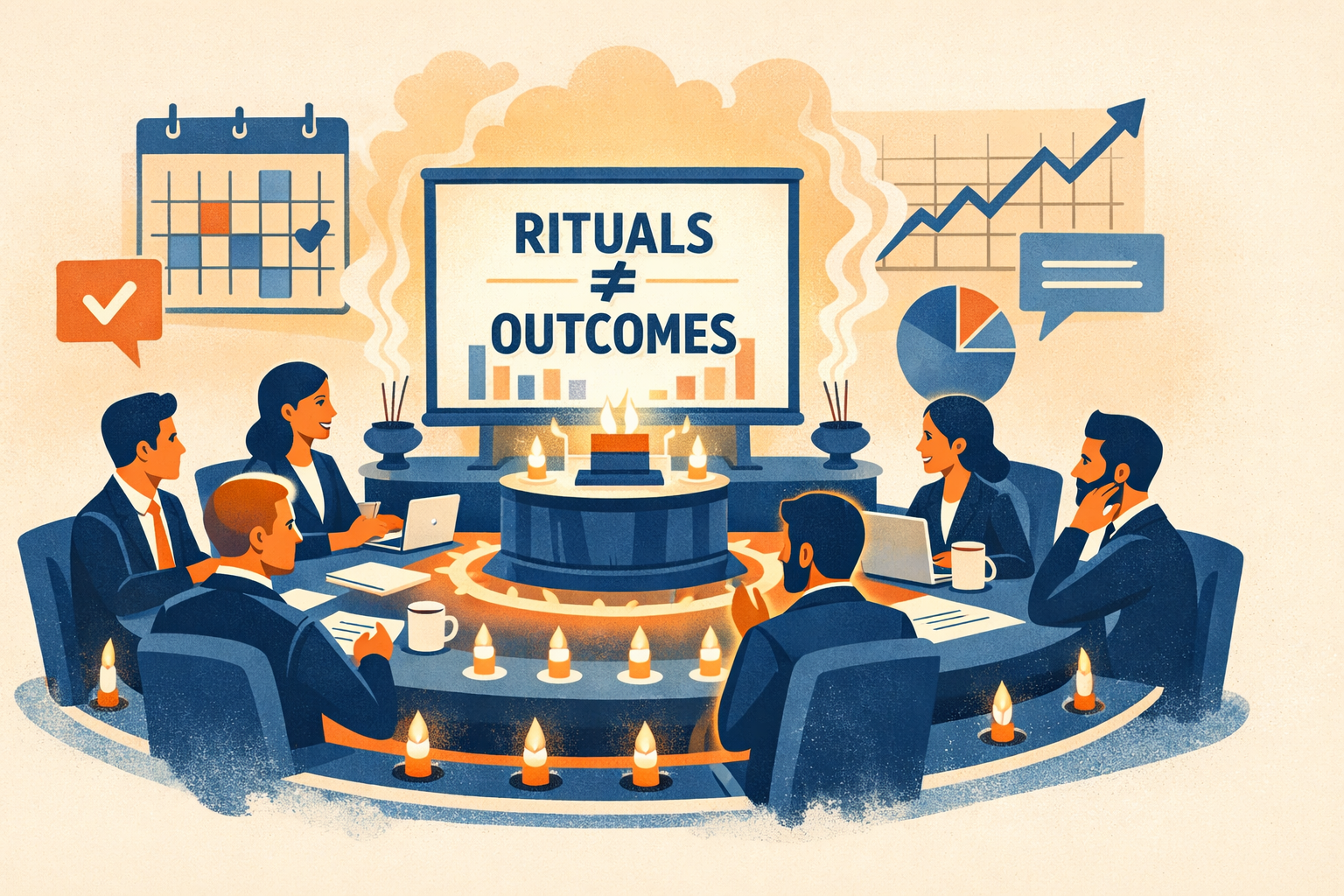
Agency Retainers don’t buy outcomes. They buy rituals.
Read Time 7 mins |
Written by: Kirko Papajanis
Don't Buy Rituals
6:40
Break free of the cult before it’s too late
Most agency retainers don’t fail because the people are bad.
They fail because the business model rewards ritual.
If you’re paying someone every month, they’ll make sure you feel like something happened every month.
So you get the same old playbook:
The weekly “sync” that could’ve been a Slack/Teams message,
The deck that restates what everyone already knows – but sure looks pretty,
The report that adds a touch of “scientific” nebulous data, and
The quarterly “strategy refresh” where the strategy is… wait for it… doing mostly more of the same, with some arbitrary tweaks to give the stakeholders the impression of “progress”.
Honestly, it’s not malicious. It’s math. Throw enough shit at the wall for long enough, and some of it will stick.
Retainers don’t buy outcomes. They buy dependably recurring proof of activity. And activity is a hell of a drug.
The Retainer Cult Has Rules
Here’s the primer on how you too can spot them.
Rule #1: Always Be Busy
If you’re not producing constant deliverables, someone gets nervous.
So work expands to fill the month.
Not because it’s needed. But, because it’s billable… and boy are you paying for it.
Rule #2: Meetings Are the Product
You don’t “review” progress. You perform progress.
Everyone leaves with notes, next steps, and a weird sense of being productive… A perfect orgasm of performative productivity.
Rule #3: Metrics Must Be Printable and Presentable
But they don’t actually have to say anything.
You’ll get a steady diet of: impressions, opens, clicks, visitors, a/b comparisons, “engagement”, MQLs, SQLs.
Realization of value is just over the horizon; you just have to stay the course.
But, if your pipeline isn’t behaving differently, your dashboard is basically a mood board.
Here’s the Uncomfortable Part
It may sound like I’m hating on marketing, but I’m not saying it’s bad, I’m just saying it can be a waste of money.
In most companies that isn't a “marketing problem.” In fact, it's a Go-To-Market execution problem.
Leads come in. (Yay, marketing is working, agency is doing great!)... but... Follow-up is slow and disjointed. Key fields in your CRM are blank. Effort is siloed. Sales stages mean something different to everyone. Deals stall. Reports are pretty, but meaningless. Forecasting is a weekly group hallucination.
NET RESULT: negligible impact on pipeline.
So what can we do?
When we continue listening to the trusted marketing agency we’ve been working with for years, and up our spend because: “results are trending well”, we pour more water into a bucket with holes…
and everyone celebrates that you poured more water.
Outbound Is Where Retainer Logic Goes to Die
Outbound is simple in theory:
Got your targeted list - check ✅ Got the right message - check ✅ Got a good cadence – check ✅ Got KPIs to track - check ✅ X outbound activities lead to Y sales meetings lead to Z deals. Increase X to increase Z.
But most outbound programs are run like a content calendar.
A monthly “campaign.” A bunch of messages. A bunch of “touches.” A meeting about why it didn’t work, leading to "ideas": “Let’s target better” “Let’s tweak the message” “Let’s add a third email” “Let’s push SDR activity +15%”
And, you may see some results. But, if you don’t own the system, you’re renting results.
And rented results always come with a steepdependency fee.
What To Do Instead: Install Change (Then Prove It)
When deciding how KRROP can actually affect change for our clients, we thought a lot about what the default was. And, we firmly decided (against some contrary business advice) to change the narrative.
As such, we don’t sell “ongoing support.” We sell outcomes you can point to.
That’s why we work in sprints.
If at the end of the sprint we haven’t delivered the results you expected, we force ourselves to really explain why, so that it’s clear what the next steps are, to you and your staff, and for us and our processes.
Not because it’s trendy or easy. But because it forces the only thing that matters:
A finish line.
The model is boring on purpose:
Diagnose what’s actually broken
Build the fix (in your CRM, your process, your playbooks)
Prove it works (with behavior change, not vibes)
Decide what’s next: expand, iterate, inhouse, or stop
Retainers avoid the “decide” part. Sprints are designed around it.
Because finishing creates clarity.
“Results” Can’t Be Vibes Either
We’re allergic to fairytale promises.
No “3x pipeline in 30 days” nonsense. No attribution gymnastics. No vanity dashboards.
We measure operational change.
The stuff that makes revenue possible:
Stages that mean something (and get used consistently).
Follow-up that’s timely, automated, visible.
Reporting that matches reality.
Pipeline hygiene that doesn’t require heroics.
Outbound that your team can run without a vendor-shaped addiction.
If the system isn’t better, it doesn’t count.
The Real Enemy Is Headache Tolerance
Broken GTM systems stick around for one reason:
They’re familiar.
Teams can tolerate an absurd amount of pain as long as it’s the pain they know.
So they keep the retainer. Keep the meetings. Keep the dashboard.
Because stability, no matter how fake, reduces anxiety, without actually fixing anything. And, change is hard.
That’s the cult trap. And it takes guts to get out.
If You Want Content Every Month, Buy a Retainer (Maybe)
There’s no shame in paying regularly for content (although I would argue, there are better options than traditional agencies). But, despite its importance, it does nothing on its own. Activating the content shouldn't be run like a content calendar.
If you want pipeline to behave differently, stop subscribing to rituals.
INSTEAD: Buy change.
Change has a scope. Change has a finish line. Change creates proof.
And once you have proof, you don’t need a deck to convince yourself you’re making progress.
You can just… (drumroll please)… see it.
Want out?
If you’re tired of the theatre, and you're ready to get out, start with one of these::