
The Real AI Opportunity Is Not Creation. It’s Coordination.
Read Time 6 mins | Written by: Kirko Papajanis
Today's post was birthed in the bowels of LinkedIn-post hell, where I kept having a deep feeling of deja vu. Seemingly a lot of the people I'm connected to or follow have similar ideas.
But it wasn't just the ideas that were giving me that sense, it was even the specific wording.
Then something occurred to me that, in hindsight, is obvious. What this evolved to was a thesis on how, and why, people are using AI to create, when they should be using it to coordinate.
So let's begin...
Rational first moves
The first big AI use case was obvious: CONTENT. And honestly, it seemed to make perfect sense.
There is always more content to make. More emails. More landing pages. More follow-up. More social posts. More nurture tracks. More decks. More “stuff” needed to keep a go-to-market machine moving.
So, when AI showed up and made content easier to produce, teams jumped on it. Of course they did, it reduced the pain of “the blank page”. It helped lean teams move faster. It gave people a way to keep up with a market that never stops asking for more.
That was not a misuse of AI. It was a totally rational first move. But a rational first move is not the same thing as a sustainable advantage. In fact, it can be the opposite.
Cue the breakdown, with some inclusive pop culture references to prove a point.
Like Vonnegut's Harrison Bergeron (“They were equal every which way. Nobody was smarter than anybody else.”) or, more recently, Pixar's The Incredibles (“When everyone’s super… no one will be”).
When one company uses AI to create more content, it gets efficiency.
But, when every company uses AI to create more content, the market gets more self-perpetuating noise.
And, because most AI-generated work tends to pull toward the middle, a lot of that new output starts to feel familiar. Competent, maybe. Clear enough, maybe. But distinct? Doubt it.
That’s the trap. (Tempted to put another Admiral Ackbar here)
AI makes it easier to produce, but more difficult to differentiate.
So the more the market leans on AI for creation alone, the more it risks creating a flood of sameness.
More content. Less signal.
More activity. Less distinction.
More production. Harder differentiation.
That is why, I believe, the real AI opportunity is not creation, it’s coordination.
The bottleneck was never just the blank page
The blank page is annoying, but it was never the whole problem. Slop has always existed.
Most go-to-market teams are not struggling because they literally can’t produce words.
They are struggling because work is fragmented.
Signals are scattered, even more now with more disparate sources. Context is incomplete. Handoffs are messy. Priorities shift. Teams move on partial information, if at all (inertia). The next best step is often unclear, and by the time it becomes clear, the moment has passed.
That is a coordination problem.
And that is where AI gets WAY more interesting.
Not when it is used to crank out another paragraph. But when it helps a business connect dots faster and act with more nuance.
Not more output. Better motion.
Creation makes assets. Coordination makes progress.
That’s the distinction.
Creation is useful. It gives you drafts, summaries, posts, emails, decks, copy.
Coordination is different. It helps teams understand what is happening, what matters, and what should happen next.
That might mean helping marketing see which accounts are actually showing meaningful intent before launching another generic nurture stream.
It might mean helping sales understand what changed in an account based on call notes, CRM activity, stakeholder movement, and product signals before sending the next follow-up.
It might mean helping revenue operations spot friction earlier, identify where the funnel is degrading, and surface where intervention actually matters.
It might mean helping customer teams connect support issues, adoption changes, and stakeholder turnover into a clearer picture of account risk.
Those aren’t the flashy AI demos. They’re harder to package. Harder to screenshot.
It’s way easier to point to a slew of new LinkedIn posts with thousands of engagements, and say: “wow, look at all of that”, than it is to define subtle decision-making tweaks that could have a profound impact on funnel velocity, and, in turn, a 20% reduction in time-to-value.
The market does not need more generated language
What it needs is better interpretation. Better timing. Better decisions. Better follow-through.
This is the problem with over-indexing on content creation as the AI story. It focuses on the artifact, not the outcome.
Yes, AI can help you write the email, but can it help you understand whether the email should be sent at all?
Can it help you see that the account is stalling because legal got involved, product usage dropped, and the champion stopped attending calls?
Can it help you recognize that marketing is pushing volume into segments sales cannot convert?
Can it help you move from information to action faster, with more context?
That is a much more important capability than content generation alone.
Because businesses do not win by producing the most language. They win by making better moves.
Sameness is the real risk
This is the part I think a lot of teams are underestimating. When content gets cheaper, content volume rises. That feels good internally because throughput improves.
But externally, it means buyers are seeing more of the same.
More polished noise. More safe language.
And, most importantly, more messages that sound like they came from a machine trained on everyone else’s messaging.
In B2B, where too much messaging already sounded interchangeable before AI, this becomes a real problem real fast.
AI did not invent sameness. It just made sameness much easier to scale.
And isn’t it all about differentiation and pattern-disruption (and also emotion – more on that later).
The companies that win will operationalize AI
The winners here will not be the teams with the cleverest prompts. Nor the ones who create the most content.
They’ll be the ones that build better systems around AI.
The ones that know where AI belongs in the workflow (i.e. what machines are best at) and where human judgment (intuition, creativity, ingenuity) still matters most.
The ones that use AI to connect signals across teams rather than just producing more siloed knowledge.
The ones that use it to reduce drag around decision-making, not just slop copywriting (slopywriting?).
That is a very different level of maturity, and over time, a much more defensible one.
A personal closing note
Content creation was the obvious first chapter of AI adoption. Organizations have leaned on content as the fundamental basis of their market penetration for years. AI was positioned as the path to better, more relevant content.
But, it became an inherently dangerous one.
Gross amounts of AI content being read by AI to create more content, then being scanned by AI to build knowledge is a vicious cycle. AI’s opportunity shouldn’t lie in replacing human creativity.
Instead, why not use AI to make your business more coherent:
- To decode nuanced signals.
- To analyze subtle changes based on timing, specific wording, different iterations.
- To tighten the time between signal and action.
- To scientifically support your testing.
That’s where humans need the most help, so I choose to focus there.
For content creation, I maintain that the most impactful message is the one that evokes emotion. And I’m confident that machines aren't better at that yet.
So let's lean into our empathy and connection to one another, and allow it to guide our creativity.
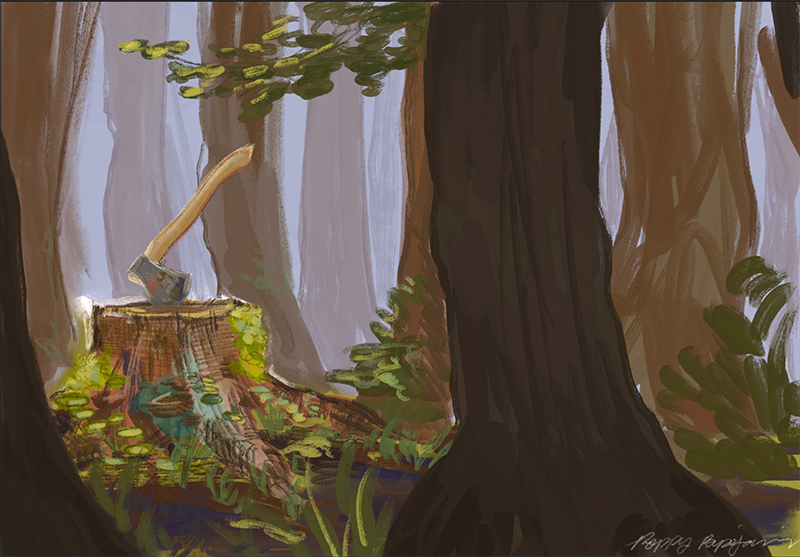
“The forest was shrinking but the trees kept voting for the axe, for the axe was clever and convinced the trees that because his handle was made of wood he was one of them.”
~ Turkish Proverb
(Featured Image art credit to @popsa.doodle)
Get the next post by email.
Leave your email and we'll let you know when there's a new one.
